AI Recap July 2026: Two Anthropic Models, a Government Review and the Open-Weight Pressure
July 2026 in AI: Sonnet 5 and Opus 5 from Anthropic, GPT-5.6 after a US review, Kimi K3 as open weights, and new GEO controls in Search Console.
Martin Rau ·
in AI Models
Anthropic's Claude model family — organized into Opus (top tier), Sonnet (balanced), and Haiku (fast, affordable), plus the newer Fable and Mythos lines. Strong at agentic work, coding, and long contexts.
July 2026 in AI: Sonnet 5 and Opus 5 from Anthropic, GPT-5.6 after a US review, Kimi K3 as open weights, and new GEO controls in Search Console.
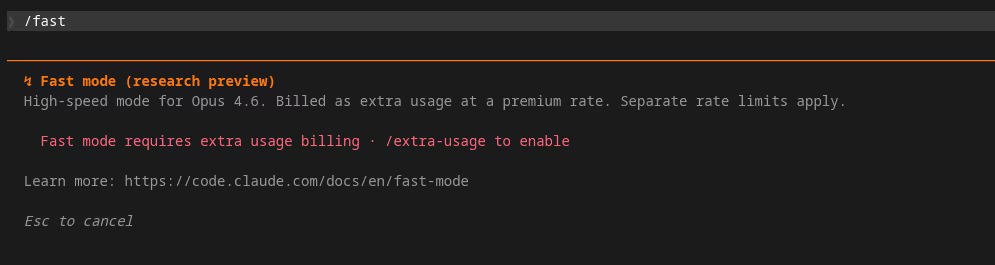
Fast Mode for Opus 4.6 is now extra-usage only. Here's how to enable it — and what it really costs you.
What we see after several weeks on Opus 4.7 in practice — token appetite, overachieving, and concrete levers to push back.
Real numbers from a customer setup with Claude Sonnet. What prompt caching delivers, when it pays off — and where the pitfalls are.
Fable 5 fixed a bug in one shot that Opus failed at twice. I'm still not switching. My honest impressions from the trenches after three days.
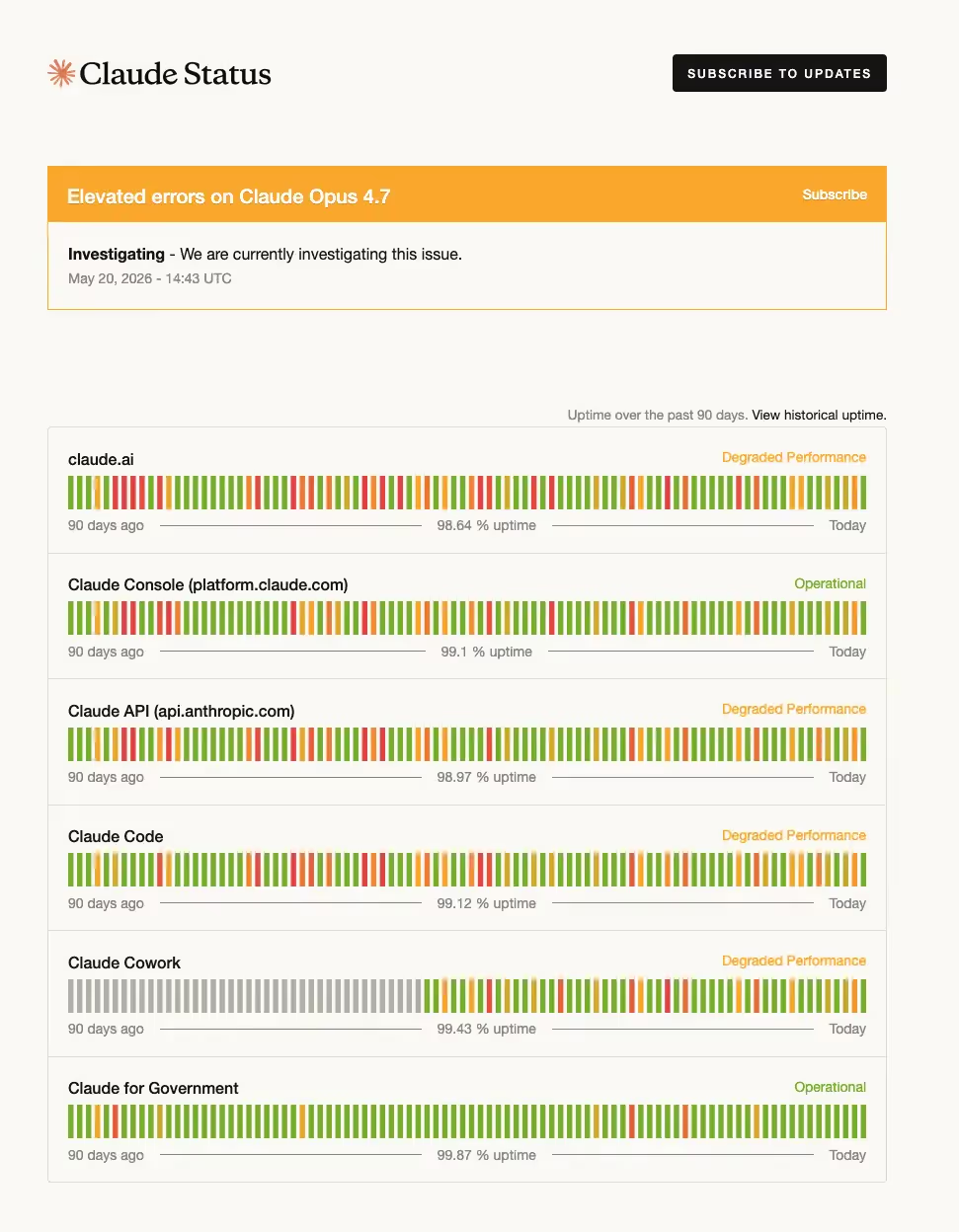
Anthropic's status board shows 98.64 % uptime. The per-day stripes tell a different story — and it's the one that matters for your work.
Anthropic's flagship Claude Fable model, released on 1 September 2026. A frontier model for demanding reasoning, coding, research and long-running agents; 1M-token context, multimodal input, proprietary access via API and the Claude apps.
Claude Haiku 4.5 is Anthropics fast compact model from October 2025 — it delivers near-Sonnet-4 performance at roughly one third of the cost and is the first Haiku model with reasoning.
Claude Mythos 5.1 (September 2026) is Anthropics frontier model for vetted cyber and life-science organizations — the same model as Fable 5.1, only with more permissive safeguards.
Anthropic's flagship Claude Opus model, released on 24 July 2026. Positioned as a powerful everyday model for knowledge work, coding and agents; proprietary access via the Claude apps and API (model ID claude-opus-5).
Claude Sonnet 5 is Anthropic's mid-tier model from June 30, 2026 — the most agentic Sonnet yet, with performance close to Opus 4.8 at $2 input and $10 output per 1M tokens.
Claude Sonnet 5.5 (September 28, 2026) is Anthropic's low-cost mid-tier model — a faster, cheaper companion to Opus 5.5, priced at $2/$10 per 1M tokens and leading on Terminal-Bench 4.0. Available via boostN.
Claude Fable 5 is Anthropics first publicly available Mythos-class model, released in June 2026. It is built for the most demanding reasoning and long-horizon agentic work and offers a one-million-token context window.
Claude Opus 4.8 is the flagship model of Anthropics Opus line, released in May 2026. It targets agentic coding, complex reasoning and computer use, and is described as an incremental but measurable improvement over Opus 4.7.
Claude Sonnet 4.5 (September 2025) is Anthropics Sonnet-line model tuned for agents and coding — leading on SWE-bench Verified at launch, since superseded by newer Sonnet versions.
Claude Sonnet 4.6 is Anthropics mid-tier model from February 2026 — close to Opus-level performance, with a 1M-token context and unchanged Sonnet pricing of 3/15 USD per million tokens.
Claude Mythos (April 2026) is Anthropic's most powerful model to date — a new tier above the Opus line, distributed primarily through the Glasswing program to cybersecurity defenders.
Claude Mythos 5 (June 9, 2026) is Anthropic's most powerful model line above Opus — technically identical to Fable 5 but without its safety classifiers, distributed through Project Glasswing.
Claude Opus 4.5 is Anthropic's top-tier model from November 2025 — the direct predecessor of Opus 4.6, bringing "Infinite Chats" and substantially reduced token usage.
Claude Opus 4.6 is Anthropic's flagship model from February 2026 — top tier of the Claude 4 family with a 1M-token context window, stronger coding and new effort controls.
Claude Opus 4.7 is Anthropic's top-tier model from April 2026 — successor to Opus 4.6 with high-resolution image processing, a new xhigh effort level and task budgets for long agentic runs.
The major model families in 2026 at a glance. Who builds Claude, GPT, Gemini, Llama, Mistral, DeepSeek, Qwen — and which model to pick when.
Claude, GPT, Gemini, Llama & co. — who builds what, where each family shines, and how to pick the right model for your own use case.
Claude Sonnet 5.5: Anthropic's mid tier next to Opus 5.5. Benchmarks, effort-based cost, breaking changes and how to choose vs Opus 5.5 and GPT-6.1 Sol.
Claude Fable is Anthropic's top reasoning line — above Opus, pricier, slower. Positioning, where it fits and how to choose it.
Claude Haiku is Anthropic's fast, low-cost line for high volume. Positioning, where it fits and how to choose it.
Claude Opus is Anthropic's pro tier for coding, agents and knowledge work — what the line stands for, where it fits and how to pick it.
Claude Sonnet is Anthropic's balanced line: more capable than Haiku, cheaper than Opus. Positioning, where it fits and how to choose it.
Anthropic discloses the numbers: Claude writes >80% of its production code. At the same time, the company argues for the option to pause frontier development.
Anthropic released Claude Fable 5.1 and Mythos 5.1. Base price holds, but cache reads are 75% cheaper and token usage drops by half.
Anthropic released Claude Opus 5.5: $4 / $20 per million tokens, about 40% cheaper to run than Opus 5 and ahead of Fable 5.1 on coding benchmarks.
Anthropic shipped Opus 5 — same token price as 4.8, and per the vendor near-Fable performance at roughly half the cost per task.
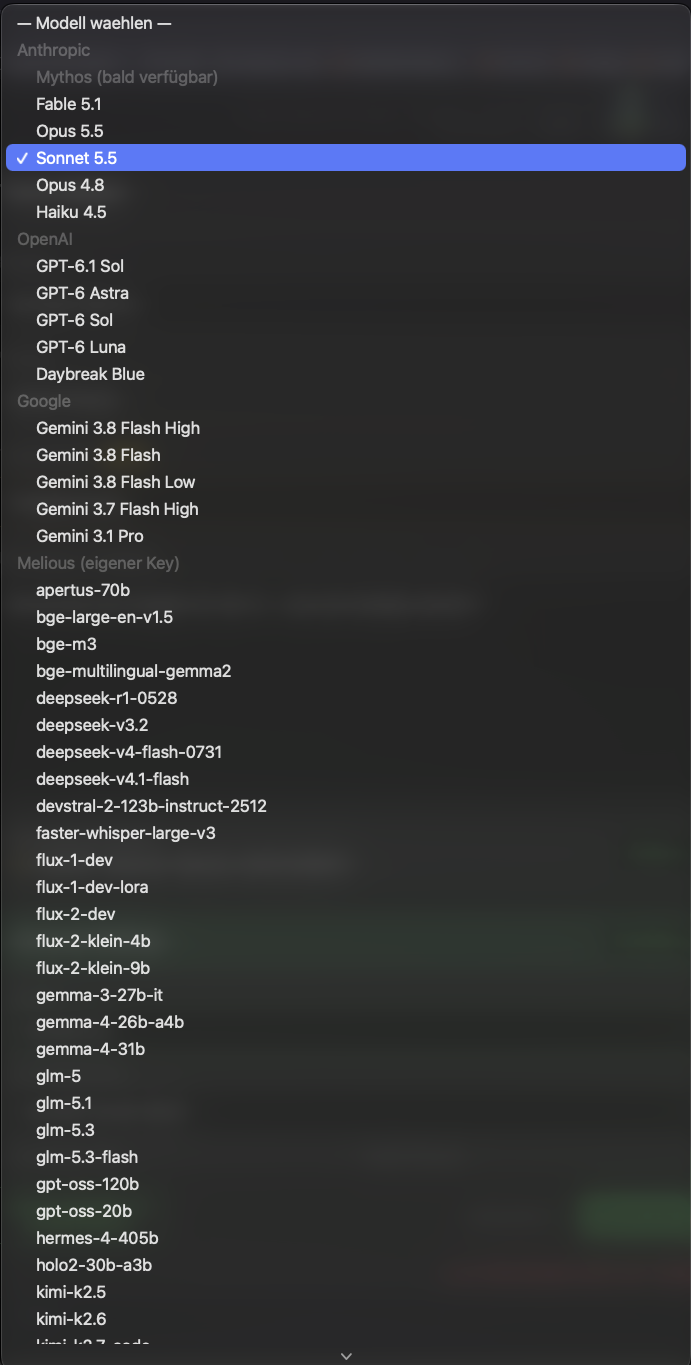
Anthropic released Claude Sonnet 5.5: $2 / $10 per million tokens, Opus-level benchmarks, but only at max effort. AA index 56 beats Astra.
An export-control directive forced Anthropic to abruptly disable its top models Fable 5 and Mythos 5 for all users on June 12, 2026. Anthropic openly objects.